

The Unfinished Story

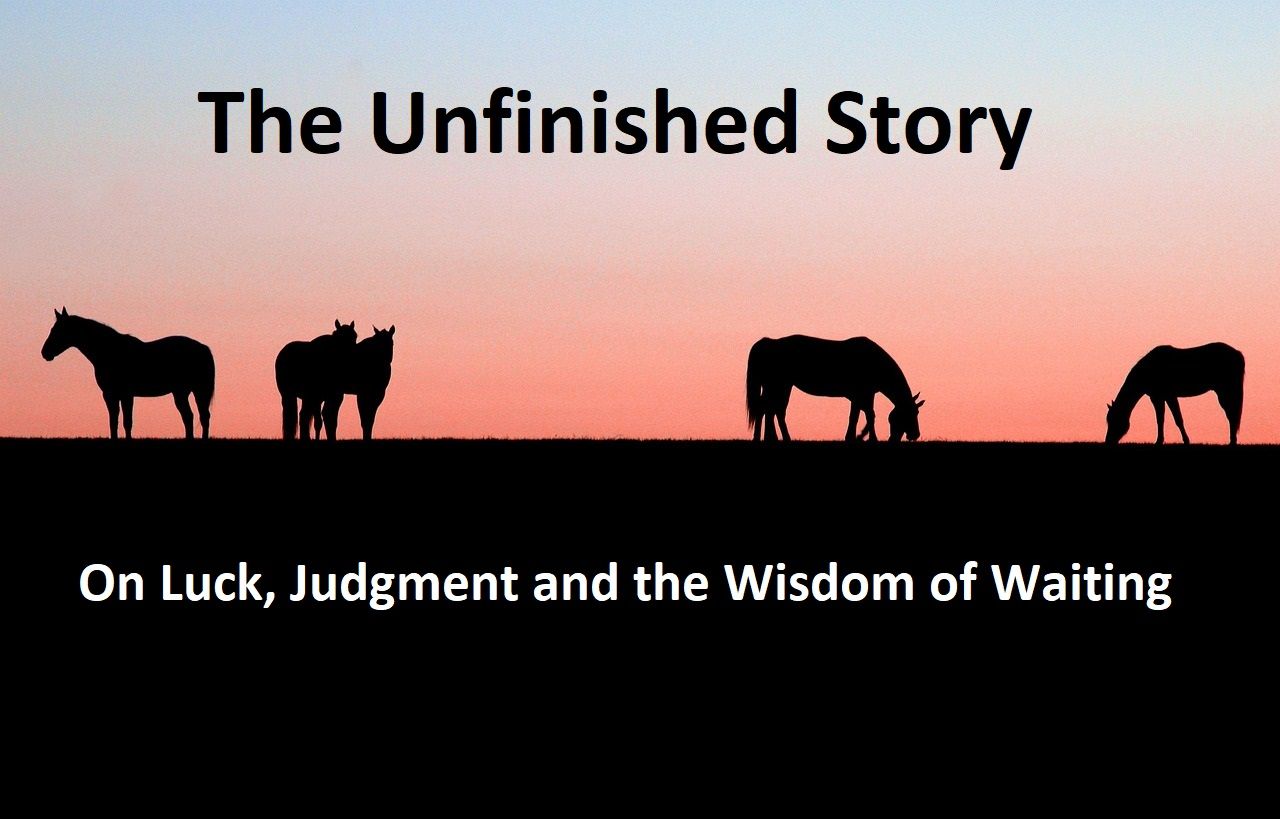
In a quiet village, there lived a farmer and his son. One morning their only horse wandered off into the mountains and did not return. The neighbors gathered at the fence, shaking their heads with sympathy.
“Such bad luck,” they said.
The farmer leaned on the wooden gate and looked out into the empty field.
“Who can say what is good and what is bad?” he replied.
Days passed. Then one evening the horse came back over the ridge, and behind it followed several wild horses from the mountains. The neighbors hurried back, their voices full of excitement.
“What good fortune!”
The farmer simply smiled and said: “Who can say what is good and what is bad?”
Soon after, the farmer’s son tried to ride one of the wild horses. The animal bucked violently, throwing him to the ground. His leg broke with a sharp crack, and he could not walk without crutches.
Again, the neighbors gathered.
“How terrible,” they said.
The farmer looked at his son, then at the sky stretching wide above the fields and said:
“Who can say what is good and what is bad?”
A few weeks later, soldiers came marching through the village, taking every able-bodied young man to fight in a distant war. When they saw the boy’s broken leg, they passed over him and moved on.
The neighbors returned once more, amazed.
“How fortunate!”
And the farmer, as always, answered with a smile:
“Who can say what is good and what is bad?”
Judgment and Suffering
This ancient Taoist story mirrors something deeply human. We rush to declare each experience as good or bad as if a momentary snapshot can reveal the bigger picture. We judge the story before it has finished telling itself.
Judgment is a byproduct of this limited perspective—and this limitation fuels our anxiety.
Our suffering often begins there—in that hurried certainty. A door closes and we call it loss. A plan succeeds and we call it victory.
Yet time has a way of bending these labels, dissolving them, revealing hidden threads we couldn’t see when the moment first arrived.
Once we give credibility to the idea that something is bad—we can spend days, weeks or months in a mindset that seeks to validate and exacerbate our suffering.
The Way of Nature
Nature is beyond judgment—it simply promotes growth and change. The forest does not mourn the fallen leaf, nor classify a storm as good or bad. The burned field becomes fertile ground. Winter’s stillness hides the quiet preparation of spring.
What appears broken is what we see in the middle of its transformation.
The farmer understands something simple but profound: life moves in unfolding circles, not isolated snapshots. Each moment is only the turning of a wheel.
When we insist on naming it too quickly—good, bad, fortune, disaster—we project our limited understanding onto a much larger pattern.
Meaning of Change
Events are sometimes how life breaks us open, but the suffering actually emerges because of judgment. We frame a moment and declare it final, as though the river will never move again.
But life is not a photograph; it is a current. The heartbreak that seems unbearable may soften us into compassion years later. The closed door that feels like loss may guide us toward a path we would never have chosen willingly.
Time reveals what judgment cannot see.
The Taoist Way
There is a gentler way to live. To meet each moment with a little more space. To ask, as the farmer does: who can say what is good or bad?
When we allow the story to breathe beyond the moment, we begin to see life as the forest sees it: cycles within cycles, endings that feed beginnings, loss braided quietly with becoming.
And in that wider view, the harsh lines of good and bad soften into something more spacious.
We see the story is still moving, still turning, still evolving into what it will be.
We are able to see that what first appears as the end is actually a new beginning.