

Emergence

Watch Video
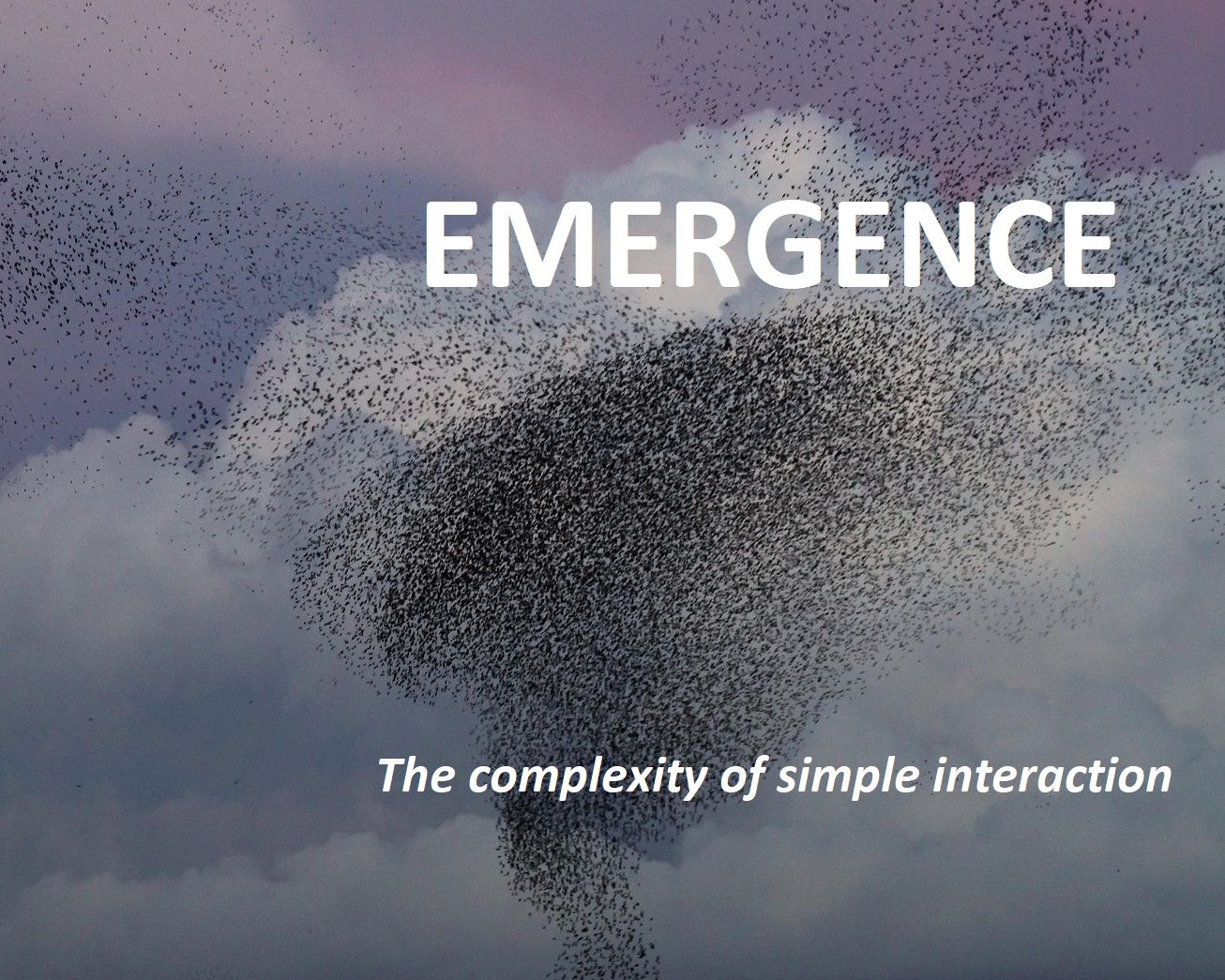
A flock of starlings moves through the sky in a breathtaking dance of choreography.
As a group, they haven’t set out to create this amazing synchronization. Each bird is quietly drawn by an instinctive urge to belong. Focused only on neighboring birds, each avoids collision by matching speed and direction.
The result is Emergence: an alignment that harmonizes the choices of countless individuals.
Whether fish, birds or eco-systems, these symbiotic patterns reveal the shape of a larger organism.
We see this in humans too. Cells and molecules create organs, consciousness and emotions. But what we will rise to become will always be greater than these individual mechanisms.
This is what makes emergence in nature so profound. Simple components interacting over time can produce beauty, intelligence, and complexity that transcends the sum of its parts.
We may view the world as a collection of things—separate, distinct, and self-contained—but when we look more closely, nothing in nature is truly a thing.
Everything is a process.
The tree isn’t just standing there. It is pulling water from the soil, exchanging gases with the atmosphere, converting sunlight into energy. It feeds and provides shelter for countless lifeforms.
What appears to be a static object is actually one aspect of a larger motion.
We see a river, but the water is always changing. It evolves season by season, stone by stone, drop by drop. What seems permanent is actually a flow.
Nature doesn't just create things—it creates processes that keep creating new things.
A flower blooms, attracting a bee. The bee carries pollen to another flower. Seed pods whirl or attach to the fur of passing animals and new plants grow.
Life generates the conditions for more life.
And the bee is not merely living in the meadow. The bee is helping to create the meadow.
The meadow is not merely hosting the bee. The meadow is helping to create the bee.
Each shapes the other.
So, if reality is fundamentally a process, then a person is not a fixed object but part of something larger. Part of this flow.
We too, are exchanging gases with the environment and are made of the same raw elements as the Earth.
Your body replaces cells. Your beliefs change. There may be continuity, but the continuity is more like a flame. You too, are sustained by the synergy that surrounds you.
This shifts the question from “What am I?” to “How is life shaping what I may become?”
Perhaps this is one of nature's most profound lessons.
We often imagine success as arrival, to establish ourselves, to become fixed and complete. Yet nothing in nature is ever complete.
We learn that growth is not a deviation from who we are. Growth is who we are.
Your experiences, relationships, failures, joys, losses, and discoveries have reshaped you countless times. Yet through all that change, there is continuity—not because you remained the same, but because you continued.
In this way, you become more than your idea of what you might be.
Meaning too, is not something to be discovered. It emerges and remains fluid as you grow.
Meaning, like life, is a living process.
Nature's genius is not that it creates beautiful things, but how it creates systems capable of generating more beauty, more complexity, more possibility, and more life.
The world is not a museum of finished masterpieces.
It is an ongoing act of creation.
And perhaps our place within it is not to stand apart and observe, but to participate consciously in that creation.
To contribute.
To nurture.
To connect.
To become.
Because as an expression of a larger living continuum—one that shaped us and continues to evolve through us—the question is not simply what we are.
The more important question is what we are helping to create.